The Cards Concept
If you've ever held a deck of cards, you've probably never stopped to think about why there are exactly 52 of them, or why we have Kings, Queens, and Jacks instead of just numbers from 1 to 13. The truth is, the standard deck of cards isn't just a random collection of paper—it's a mathematical and philosophical calendar that humans have been carrying around for centuries.
The Calendar Connection: 52 Weeks, 4 Seasons
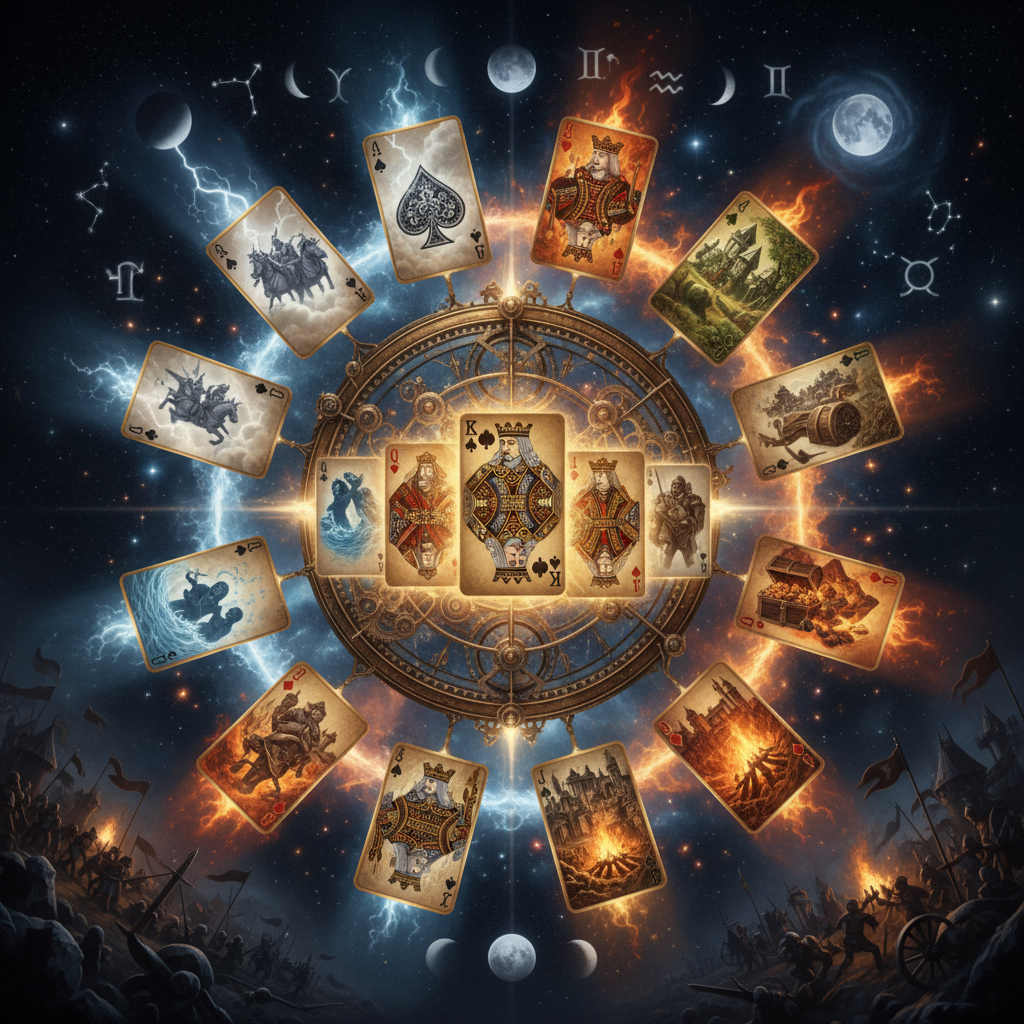
The structure of a deck is actually a massive calendar. There are 52 cards in a deck, representing the 52 weeks in a year. The four suits (Spades, Hearts, Diamonds, Clubs) represent the four seasons: Winter, Autumn, Spring, and Summer.
It goes even deeper. Each suit has 13 cards, which perfectly aligns with the 13 lunar cycles in a year. If you take the numerical value of every card in the deck (where a Jack is 11, Queen is 12, and King is 13) and add them all up, you get 364. Add a single Joker, and you have 365—the exact number of days in a year.
Ancient Philosophy and the Face Cards
The face cards—Kings, Queens, and Jacks—aren't just there to look pretty. Historically, they symbolized the hierarchy of ancient society and medieval philosophy. The King represents the rulers and the ultimate authority, the Queen represents wisdom and lineage, and the Jack (or Knave) represents the working class or the soldiers.
Even the suits themselves had social meaning. Spades represented the military (spears), Hearts represented the clergy or the church, Diamonds represented the merchant class (wealth), and Clubs represented agriculture and the peasantry.
How This Translates to Playing Seep
- The Value of Spades: In Seep, Spades carry almost all the points. Now it makes sense why—they represent the military, the ultimate power in ancient hierarchies. Capturing Spades is literally capturing the most powerful pieces on the board.
- The Face Card Anchors: Building a house of 13 (a King) is the strongest move you can make in Seep. It represents the top of the social ladder. No card can break a King, making it the safest mathematical structure you can build on the floor.
A Mathematical System Built by People
What’s fascinating is that nobody sat down one day and said, "Let's invent a 52-card game system." It evolved naturally over hundreds of years as people from different cultures traded, traveled, and merged their games together. The deck survived because the math is perfect.
When you play a game today, you are participating in a system that thousands of generations helped balance. The reason a game like Seep feels so satisfying when you pull off a massive sweep isn't just luck; it's because the underlying math of the deck guarantees that every card you track and remember pays off in the end.
Social Systems, Wars, and How Cards Reflected Society
If you look closely, playing cards were basically a snapshot of how people lived during massive social shifts and wars. Back in the day, military campaigns were brutal, and soldiers spent months just sitting around waiting for orders. Cards became a way to simulate war without actually dying. You build your defenses (like a house of 12), you send out your troops (your spades), and you try to capture the enemy's resources.
But it wasn't just about fighting. As society developed, the games evolved. Instead of just "highest card wins," games started requiring teamwork, partnerships, and social building. You had to learn to read the room. If your partner was holding back their high cards, you had to adjust your strategy. It was basically a crash course in social development, teaching people how to negotiate, bluff, and trust each other using nothing but pieces of paper.
Astrology, Zodiacs, and the Mystical Side of the Deck
Okay, this is where it gets really interesting. Before people were just playing games with them, cards were deeply tied to astrology and the zodiac system.
Remember how we talked about the four suits? In astrological traditions, those four suits correspond perfectly to the four classical elements. Spades are Air, Hearts are Water, Clubs are Fire, and Diamonds are Earth. Even the 13 cards in a suit tie back to the 13 lunar cycles of the year.
People used to lay these cards out to read fortunes, track the stars, or make huge life decisions because they believed the math of the deck mirrored the math of the universe. So next time you randomly pull a Queen of Diamonds, just know that a few hundred years ago, someone might have taken that as a sign from the stars to start a business or pack up and move to a new city.
The Human Experience of the Cards
Beyond the philosophy and the calendar math, the concept of cards is deeply human. We use them to socialize, to test our memories, and to playfully argue with our friends over who miscounted the floor.
You can know that a deck represents 52 weeks and 365 days, but in the heat of a match, all you really care about is whether your partner has that one 9 of Spades you desperately need to secure the game. The deck is ancient and mathematically perfect, but the way we play it is messy, loud, and incredibly fun.