The 7 Biggest Mistakes Beginners Make in Seep
Seep is a game that brutally punishes bad habits. A lot of new players bleed points without even realizing it, mostly because they're focused on the wrong things. If you want to stop losing close games, you have to stop making these completely avoidable errors. Let's break down the most common traps and how to actually fix them.
1. Picking Up Cards Too Early
The Mistake: You see a 5 on the board, you have a 5 in your hand, so you instantly snap it up.
Why it hurts you: By taking that single card right away, you might be ruining a much bigger move. If you had waited a turn or two, someone might have dropped a 4, letting you use a 9 from your hand to pick up both the 5 and the 4 at the same time.
The Fix: Be patient. Don't just grab a single card unless you have to. Try to wait until the board piles up a bit so you can scoop up three or four cards in one go. That's how you win the 'majority cards' bonus at the end.
2. Building a House Without the Key
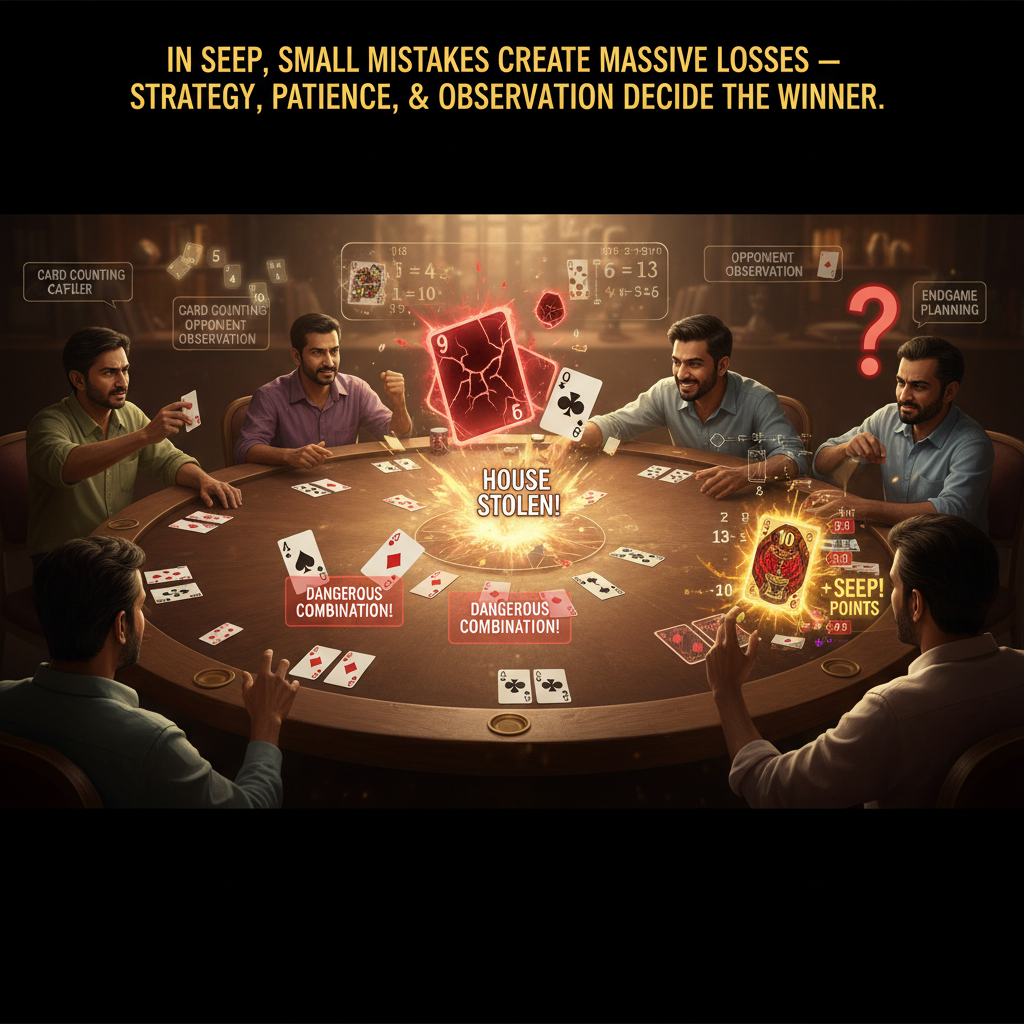
The Mistake: You put a 7 on top of a 2 to make a house of 9, but you don't actually have a 9 in your hand.
Why it hurts you: You literally just gift-wrapped those cards for your opponent. If they have a 9, they're going to take your house and thank you for it.
The Fix: This is the golden rule of Seep: never build a house if you can't capture it yourself. The only exception is if you're playing a 4-player team game and you're 100% sure your partner has the card to pick it up.
3. Forgetting About the Point Cards
The Mistake: You're so focused on picking up huge piles of cards that you completely ignore the 10 of Diamonds or the Aces.
Why it hurts you: The guy with the biggest pile of cards doesn't always win. If your opponent manages to snatch the 10 of Diamonds (which is worth a massive 6 points), they can beat you even if their pile is half the size of yours.
The Fix: Know where the points are. The 10 of Diamonds is king. The Spades matter. The Aces are worth a point each. If you have a choice between grabbing four random cards or grabbing the 10 of Diamonds, take the 10 every single time.
4. Throwing Away the Wrong Cards
The Mistake: You don't have a move, so you just randomly throw a 6 onto the board without thinking.
Why it hurts you: Your opponent might have been waiting for exactly that 6 to complete their sweep. Throwing out cards blindly is the fastest way to get completely wiped out.
The Fix: Look at the board before you throw a card away. If throwing a 4 means the board now perfectly adds up to 12, and you know your opponent has been hoarding high cards, pick a different card to throw. When in doubt, throw low-impact cards.
5. Ignoring What the Other Guy is Doing
The Mistake: Playing like it's solitaire and only looking at your own hand.
Why it hurts you: If your opponent is quietly sweeping up every Spade that hits the board, they're going to get the Spade majority bonus, and you won't even realize it until it's too late.
The Fix: Pay attention! If you see them going hard after Spades, you need to start stepping in and grabbing Spades just to block them. Half of winning at Seep is just making sure the other guy doesn't get what he wants.
6. Missing an Easy Sweep (Seep)
The Mistake: The board adds up perfectly to a card in your hand, but you miss the math and play something else.
Why it hurts you: Depending on what rules you're playing, a sweep is worth anywhere from 1 to 50 points. Missing one because you didn't do basic addition is basically throwing the game away.
The Fix: Every time it's your turn, do a quick scan. Add up all the loose cards on the floor. If they equal a King (13), and you have a King, take it immediately before someone else drops a card and ruins the math.
7. Running Out of High Cards at the End
The Mistake: You blow all your Face Cards (Jacks, Queens, Kings) in the first few rounds and get stuck with 2s and 3s for the final turn.
Why it hurts you: The end of the game is usually when the board is the messiest. If you don't have high cards left, you can't pick up anything big, and worse, you give your opponent a chance to sweep the board on the very last hand.
The Fix: Pace yourself. Try to hold onto at least one big card—like a Queen or a King—until the very end. Use your smaller cards early on for defensive plays or to build houses.
The Bottom Line
Getting better at Seep isn't about memorizing crazy mathematical formulas. It's really just about paying attention to the board, protecting the high-value point cards, and not handing free points to your opponent through careless mistakes. Fix these seven bad habits, and you'll notice a massive difference in your win rate almost immediately.