Origins and Background of Seep
Seep History at a Glance
- Category: Fishing Card Game
- Primary Origin: Northern India & Punjab (Pakistan)
- Related Games: Scopa (Italy), Casino (International)
- Etymology: Phonetic shift from English "Sweep"
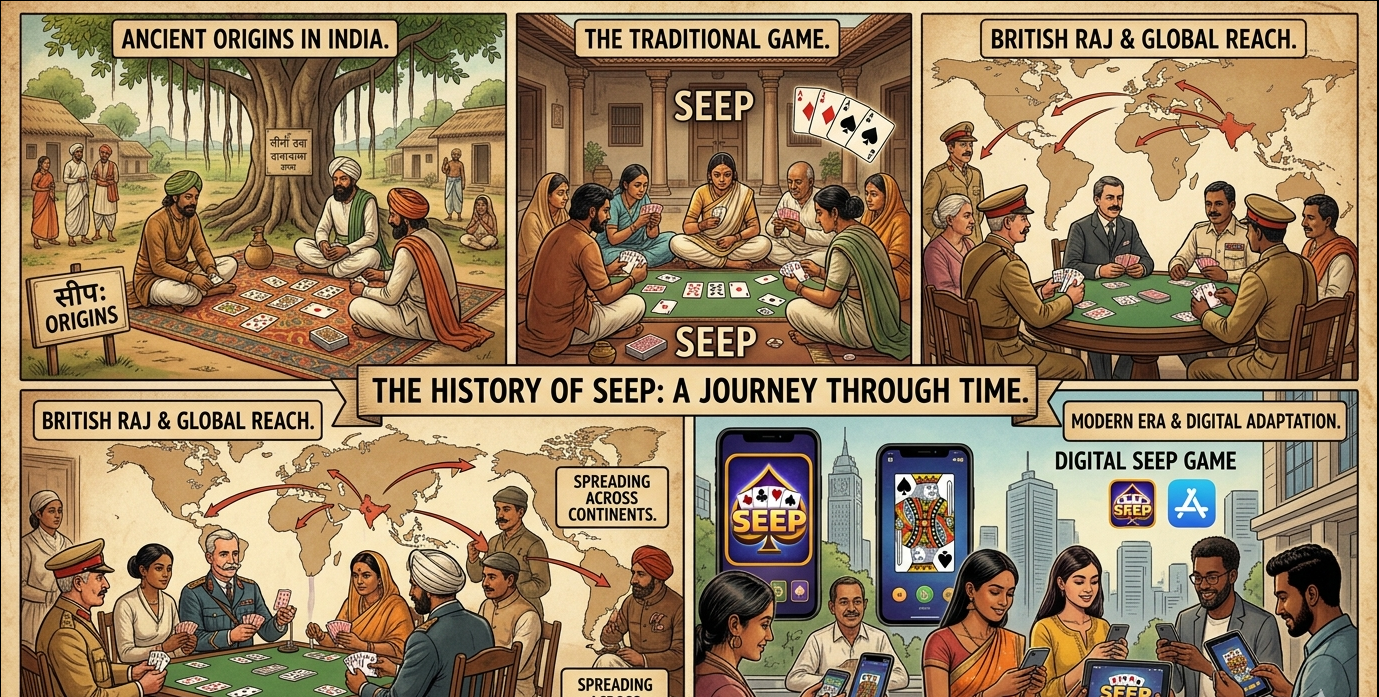
If you grew up in a household in Punjab, Delhi, or across the northern regions of India and Pakistan, you are likely familiar with Seep. It is a game that is often heard before it is seen—the distinctive sound of cards being slapped onto a table and the sudden shouts when someone clears the floor.
While the game is deeply embedded in the social fabric of South Asia, you won't find many official historical records about it. Most of what we know about Seep has been passed down through generations by word of mouth. It was never governed by a formal committee; it was shaped by the people who played it in village squares and university hostels.
How "Sweep" Became "Seep"
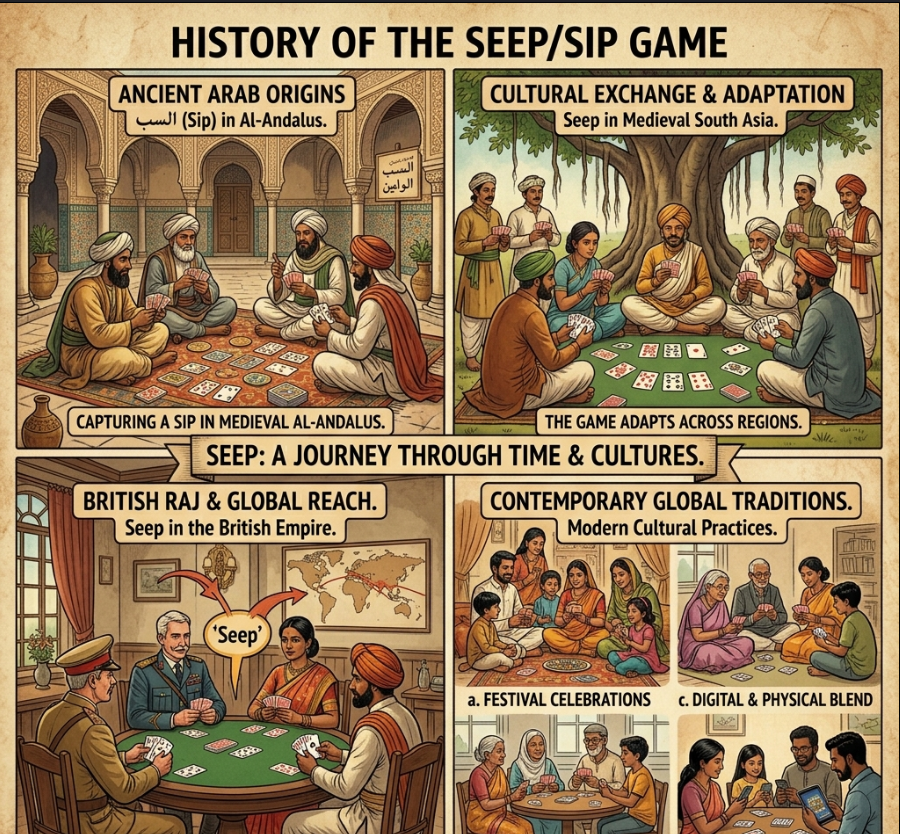
The name of the game itself tells a story about how global influences were localized. The core mechanic of the game is clearing the table of all cards to score 50 bonus points. When you do this, you have effectively "swept" the board. Over decades of being played by locals, the English word "Sweep" simply shifted in pronunciation until it became "Sip" or "Seep."
Mechanically, Seep belongs to the "fishing" family of card games, sharing DNA with international games like the Italian Scopa. However, while those games remained relatively fast and simple, Seep evolved into a much heavier, mathematically complex game with the invention of the "Ghar" (House) system.
The Bethak and The Hostel Culture
For decades, Seep was the undisputed king of the Bethak—the traditional community meeting rooms where elders would gather. In these spaces, playing Seep wasn't just a pastime; it was an extreme test of non-verbal communication. Because the game is strictly played in partnerships of two with absolute silence required, players had to learn to read their partner's mind purely based on what cards they discarded.
But the game didn't just stay with the older generation. If you walk into almost any university hostel in North India today, you will find students sitting on the floor playing Seep late into the night. This "hostel culture" has ensured that the game survived the transition into the modern era, bridging the gap between traditional family gatherings and youth culture.
Oral Traditions and Regional Arguments
Because Seep survived strictly as an oral tradition without a printed rulebook, it developed dozens of regional variations. This is why a player from Delhi might argue with a player from Lahore over how a "Pucca Ghar" (Strong House) is allowed to be broken.
Some regions play fast games up to 100 points, while others play grueling marathon sessions up to 500 points. These slight variations in rules are actually part of the charm. Whenever players from different cities meet, the first five minutes are always spent arguing about and agreeing upon which specific set of rules they are going to honor for the night.
The Train Journey Phenomenon
You can't talk about the history of Seep without mentioning the Indian Railway system. Before smartphones and tablets, a 24-hour train journey from Delhi to Mumbai required serious entertainment. Seep became the undisputed king of the train cabin.
Players would use a suitcase or a newspaper as a makeshift table. Because the game takes about 15 to 20 minutes per round and requires constant mental arithmetic, it was the perfect way to make a long journey disappear. It was also a fantastic icebreaker; it wasn't uncommon for complete strangers sharing a train compartment to form Seep partnerships that lasted the entire journey, only to never see each other again once the train reached the station.
The Physical Toll on the Deck
If you ever find a deck of cards in a South Asian household, you can instantly tell if it's used for Seep. In Seep, scoring a point or sweeping the board isn't just a quiet affair—it requires you to physically slap the card onto the table to assert dominance.
Because of this, specific cards bear the scars of the game. The 10 of Diamonds (worth 6 points) and the high-value Spades are usually bent, faded, or slightly creased from being slammed down so aggressively. A brand new, slippery deck of cards is actually considered annoying by veteran players, who prefer a worn-in deck that has "seen some battles" and is easier to grip.
Generational Math Lessons
Historically, many card games were frowned upon by elders as a waste of time. Seep was the rare exception. Because the game requires you to mentally track the point values of 17 specific cards (the Spades, the Aces, the 10 of Diamonds) while simultaneously doing addition to build "Houses" of 9, 10, 11, 12, or 13, it was essentially a covert math class.
Grandparents would actively encourage kids to play as a way to sharpen their mental arithmetic and memory. If a kid forgot that three Kings had already been played and blindly built a house of 13, they would get a stern lecture—not just about losing the game, but about lacking focus. It was a rigorous mental workout disguised as a leisure activity.
Moving into the Digital Age
As people moved away from their hometowns, the traditional Bethak became harder to find. But the South Asian diaspora took the game with them across the globe. The shift to digital gameplay was inevitable, allowing friends in Toronto, London, and New Delhi to continue their games online.
The challenge for the digital era is keeping the spirit of the game alive. Real Seep relies on memory, calculating the remaining cards, and trusting your partner. It is a game of skill, not luck. By documenting its history and maintaining a space to play, the community ensures that this incredible mathematical tradition won't be lost to time.