The Seep Game in Cards: An Overview

If you've been hearing about the "Seep game in cards" and want to know what it is, you're in the right place. Seep is a highly strategic, 4-player card game played with a standard 52-card deck that perfectly combines math, memory, and teamwork.
The 52-Card Deck Configuration
The game is played using a standard international 52-card deck. Before playing, you must remove any Jokers from the deck, as they serve no purpose in Seep.
Unlike Poker or Rummy where all four suits are treated equally, Seep places massive importance on a single suit: Spades. Almost all the game's points are concentrated in the Spades suit. Because of this, holding Spades in your hand completely dictates your strategy for the round.
What Makes the Seep Game Unique?
Most trick-taking games (like Hearts, Bridge, or Spades) rely on following the lead suit and playing the highest card to win the trick. The Seep game works completely differently. Instead of suits dictating who wins a trick, math and values dictate who captures cards.
Cards are placed in the center of the table (the floor). On your turn, you use a card from your hand to capture cards on the floor that match its exact numerical value, or whose combined values equal your card (e.g., using a 9 from your hand to capture a 5 and a 4 from the floor). Face cards hold numerical values: Jack is 11, Queen is 12, King is 13.
The Points That Matter
In the Seep card game, you don't just want to capture lots of cards; you want to capture the right cards. There are exactly 100 points total in the deck:
- All Spades (91 Points): The Spades suit carries the vast majority of the points. The King is worth 13, Queen 12, Jack 11, and the pip cards are worth their face value down to the Ace (1).
- 10 of Diamonds (6 Points): The single most valuable non-face card in the entire game. Players will aggressively fight to capture this specific card.
- The Remaining Aces (3 Points): The Ace of Clubs, Hearts, and Diamonds are worth 1 point each.
The "Seep" Bonus
The game gets its name from its most exciting move. If a player captures every single card remaining on the floor with one play (leaving the table completely empty), they score a "Seep." This grants a massive 50-point bonus and completely shifts the momentum of the game, making board-clearing a constant threat.
The Psychology of Seep: Mind Games & Tells
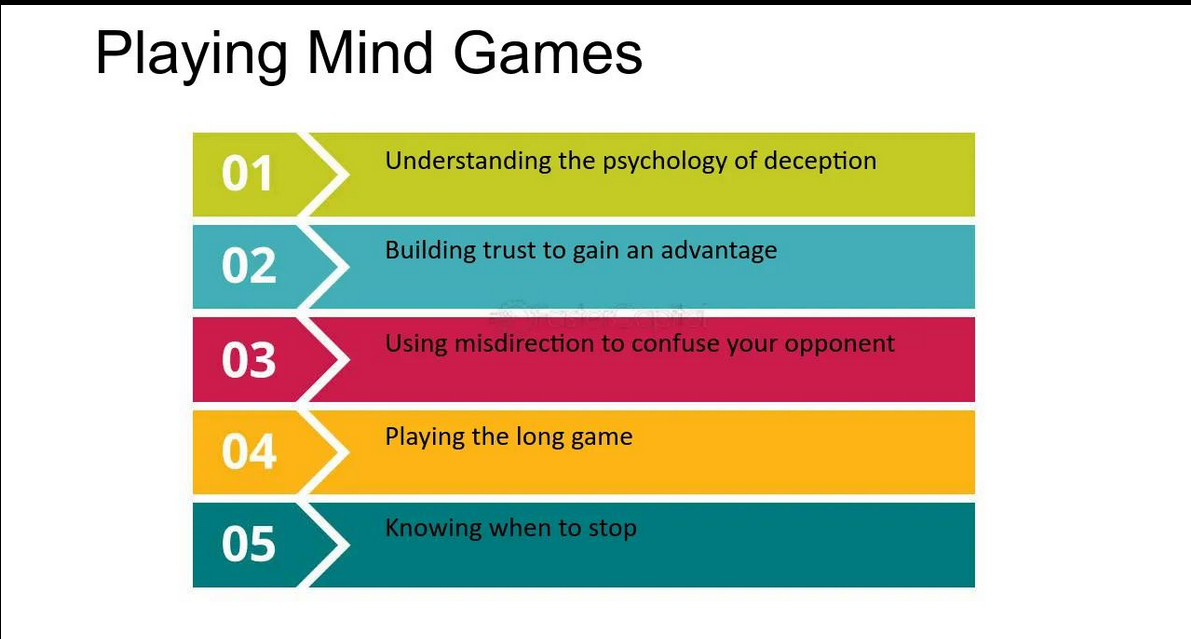
While Seep is heavily reliant on mathematics and memory, the psychological aspect of the game is what separates good players from true masters. In a 4-player game where you cannot openly communicate with your partner, every single card played is a signal. Skilled players learn to read these signals and manipulate their opponents into making critical errors.
One of the most common psychological tactics is the "False Build." An opponent might intentionally build a Kacha Ghar (loose house) of 11, knowing full well that they hold the Jack of Spades. By leaving it vulnerable for a turn, they bait the opposing team into trying to hijack it to a 12 or 13. Once the opponent commits their high card to hijack the house, the original player—or their partner—can swoop in and capture the newly enlarged house, securing even more points. This requires nerves of steel and an intimate understanding of the cards remaining in the deck.
Another crucial element is reading hesitation. If an opponent takes an unusually long time to play a card when the floor is relatively empty, they are likely holding a hand full of high-value Spades but lack the lower cards needed to safely build or capture. Recognizing this hesitation allows you to "starve" the board, deliberately playing low-value red cards to force them into a desperate throw.
Tournament Rules & Competitive Play Adjustments
When playing Seep in a casual setting at home, families often employ "house rules" to make the game more forgiving. However, in competitive tournaments, the rules are strictly enforced, and the margin for error is zero. Understanding these strict tournament rules is essential for anyone looking to play Seep at a high level.
The Misdeal Penalty: In casual play, if a player bids a number but forgets they don't hold the corresponding card, they might just be allowed to take the bid back. In tournament play, a false bid is heavily penalized. The offending team instantly forfeits the round, and the opposing team is awarded a flat 50-point penalty score.
Strict Silence: During a tournament, absolutely no "table talk" is permitted. You cannot sigh, you cannot tap the table, and you cannot make eye contact with your partner to indicate a desired move. All communication must occur strictly through the mathematical language of the cards played on the floor. Breaking this rule results in an immediate warning, followed by disqualification.
Timed Turns: High-level Seep matches often utilize chess clocks to ensure the game maintains a brisk pace. Players typically have no more than 15 to 30 seconds to make their move. This pressure forces players to calculate board combinations instantly, heavily favoring those who have practiced their mental math.
Advanced Mathematical Tracking Strategy
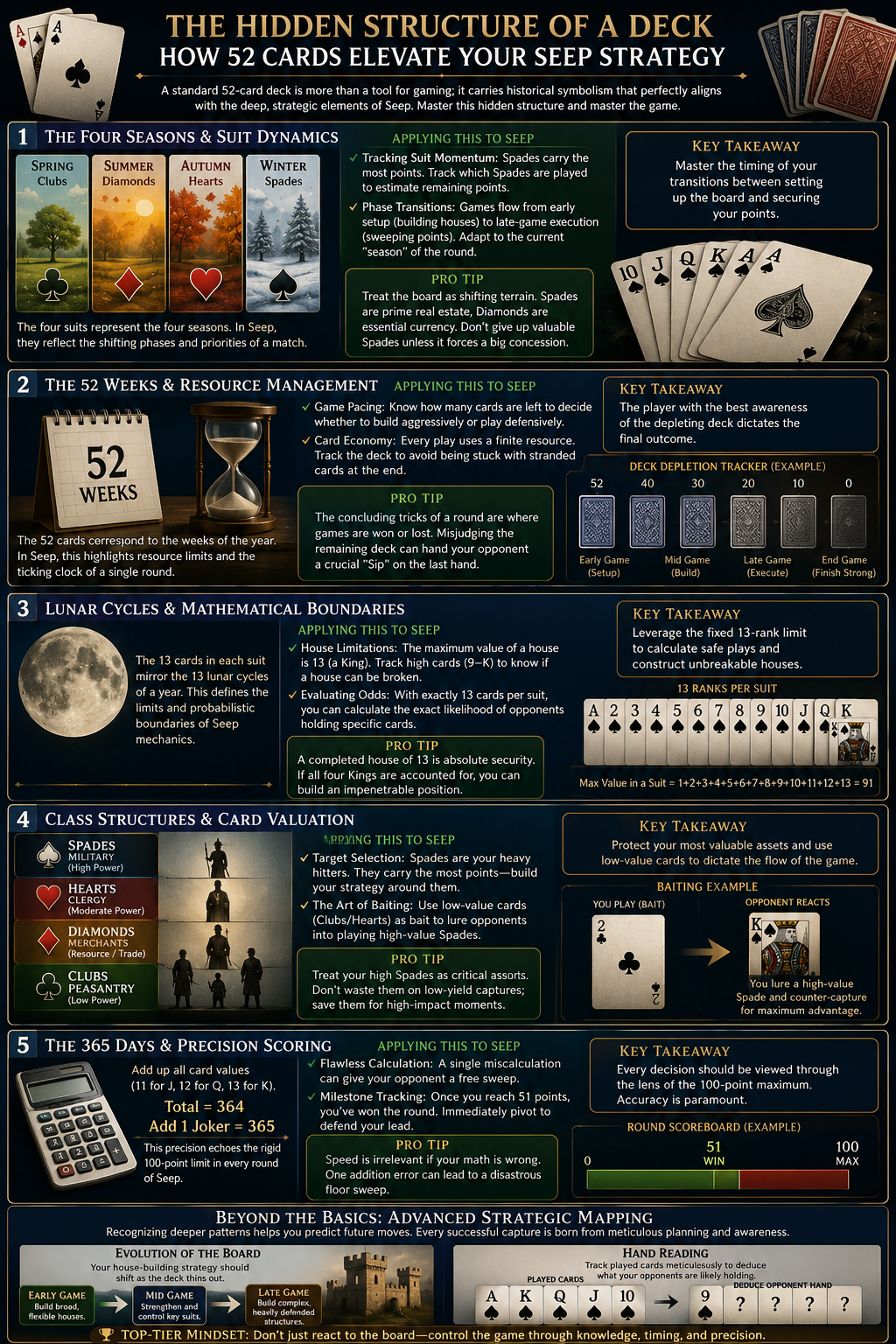
To truly excel at Seep, you must transition from playing the cards in your hand to playing the cards in the deck. This is achieved through advanced mathematical tracking. You do not need to memorize the exact location of all 52 cards, but you must keep a running mental tally of the game's core point drivers.
First and foremost, track the Power Spades. There are four Spades that matter more than any other cards in the deck: The King (13), Queen (12), Jack (11), and 10 of Spades (10). These four cards alone account for 46 of the 100 available points. If you know that the King and Queen have already been captured, the highest possible house value remaining in the game is 11. This completely changes how safely you can build houses on the floor.
Secondly, track the 10 of Diamonds. Because it is the only red card worth significant points (6 points), its appearance on the board always triggers a skirmish. If the 10 of Diamonds has not yet been played, you should actively avoid building houses of 10 unless you have a secure way to make it a Pucca Ghar. Leaving a Kacha Ghar of 10 on the board is an open invitation for an opponent to drop the 10 of Diamonds into it and hijack the points.
By combining psychological awareness, strict adherence to competitive rules, and rigorous mathematical tracking, you elevate your Seep gameplay from a game of chance to a masterclass in strategy.
Frequently Asked Questions
Can you play with a 54-card deck?
No, the two Jokers must be removed. The math of the game requires exactly 52 cards to ensure the 100-point total is balanced perfectly across the 4 players.
Are red cards useless?
Other than the 10 of Diamonds and the red Aces, all red cards are worth 0 points. However, they are still extremely useful for building houses and capturing Spades.
Ready to Play?
Test your strategy and play the best online Seep game directly in your browser. No downloads or signup required.
Play Seep Online Now