How to Actually Win at Seep (Without Overthinking)
If you've played Seep for more than a week, you've probably hit a wall where it feels like your opponents are just luckier than you. They always seem to have the exact card they need to steal your house, or they manage to hit a 50-point sweep right when you thought you were safe. But it's not luck—it's just that Seep rewards players who know what not to do.
Forget about complex probability math for a second. Here is the actual, ground-level advice that experienced players use to win consistently.
1. Stop Picking Up the Trash
The biggest mistake beginners make is trying to capture every single card on the floor as soon as they can. If there is a 3 of Clubs and a 4 of Hearts sitting there, leave them alone!
Low cards are the building blocks of the game. If you sweep up all the low cards early, you give your opponent a completely blank floor. That means on their next turn, they can drop a King or a Queen with absolutely zero risk of you hijacking it because there are no small cards to build with. Always leave a messy floor if you aren't getting Spades or serious points.
2. Track the Kings and Queens (The Rule of 4)
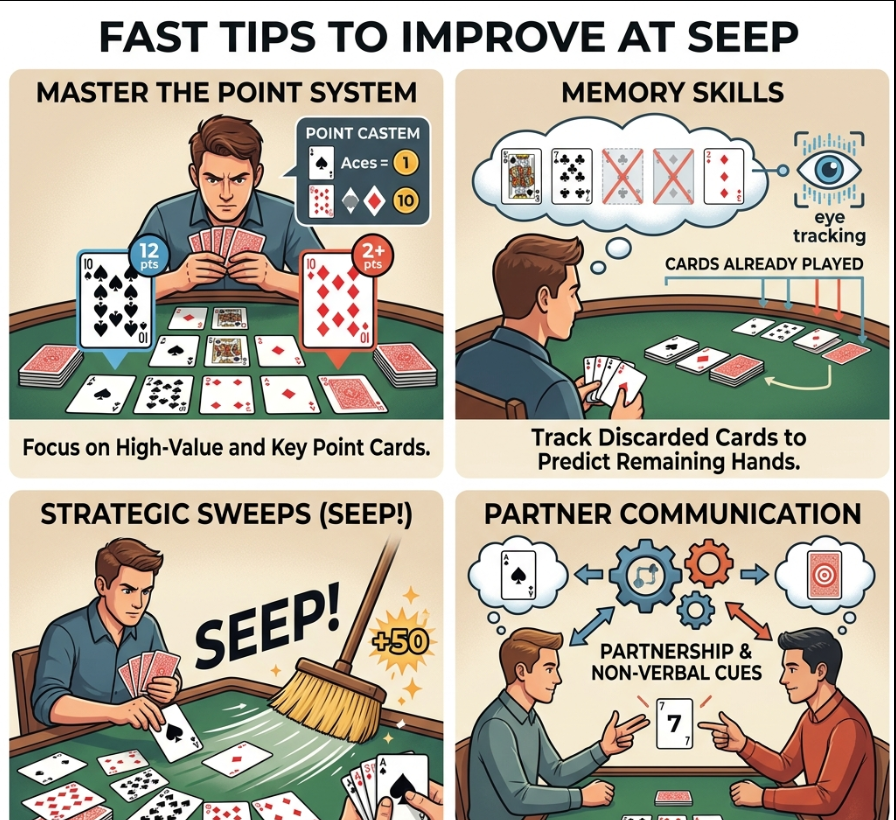
You don't need a photographic memory to be good at Seep, but you do need to know how to count to four. There are only four Kings in the deck. If you see two Kings get captured, and you are holding the third King in your hand... that means there is only one King left in the wild.
Why does this matter? Because if you build a house of 13, there is only a 25% chance your opponent has the card to steal it. Track the face cards. Once you know what's gone, building houses becomes completely safe.
3. The 10 of Diamonds is a Trap
Everyone knows the 10 of Diamonds is worth 6 points, making it one of the most valuable cards in the game. But the way people play it is hilarious. They will hold onto the 10 of Diamonds for the entire match, waiting for the "perfect moment" to capture it, only to be forced to throw it away at the very end when they run out of moves.
If you have the 10 of Diamonds and a way to capture it, do it early. Secure the points and get it off your mind. Holding onto it just clogs up your hand and limits your options.
4. Learn to "Bait" with Weak Spades
Spades are the currency of Seep. If you want to know what your opponent is holding, throw a low Spade (like a 2 or a 3) onto the floor.
Because Spades carry points, players are instinctively greedy. They will often burn a high-value capture card just to scoop up that tiny 2 of Spades. By sacrificing a 1-point card, you just forced your opponent to reveal their hand strength and waste a capture card. It’s the easiest trade deal in the game.

5. When Your Hand is Terrible, Play Defense
Sometimes you get dealt a hand with zero Spades and no face cards. It happens. The mistake people make is trying to play aggressively anyway.
If your hand is garbage, your only job is to annoy the opponent. Clutter the board. Break their houses if you can. Throw cards that you know have already been played (so they can't be paired). Your goal isn't to score points; your goal is to make sure the opponent scores as little as possible until the next hand is dealt.