What Cards Represent
A standard 52-card deck is more than just a tool for gaming; it carries historical symbolism that perfectly aligns with the deep, strategic elements of Seep. Understanding this hidden structure can elevate your gameplay from casual to masterful.
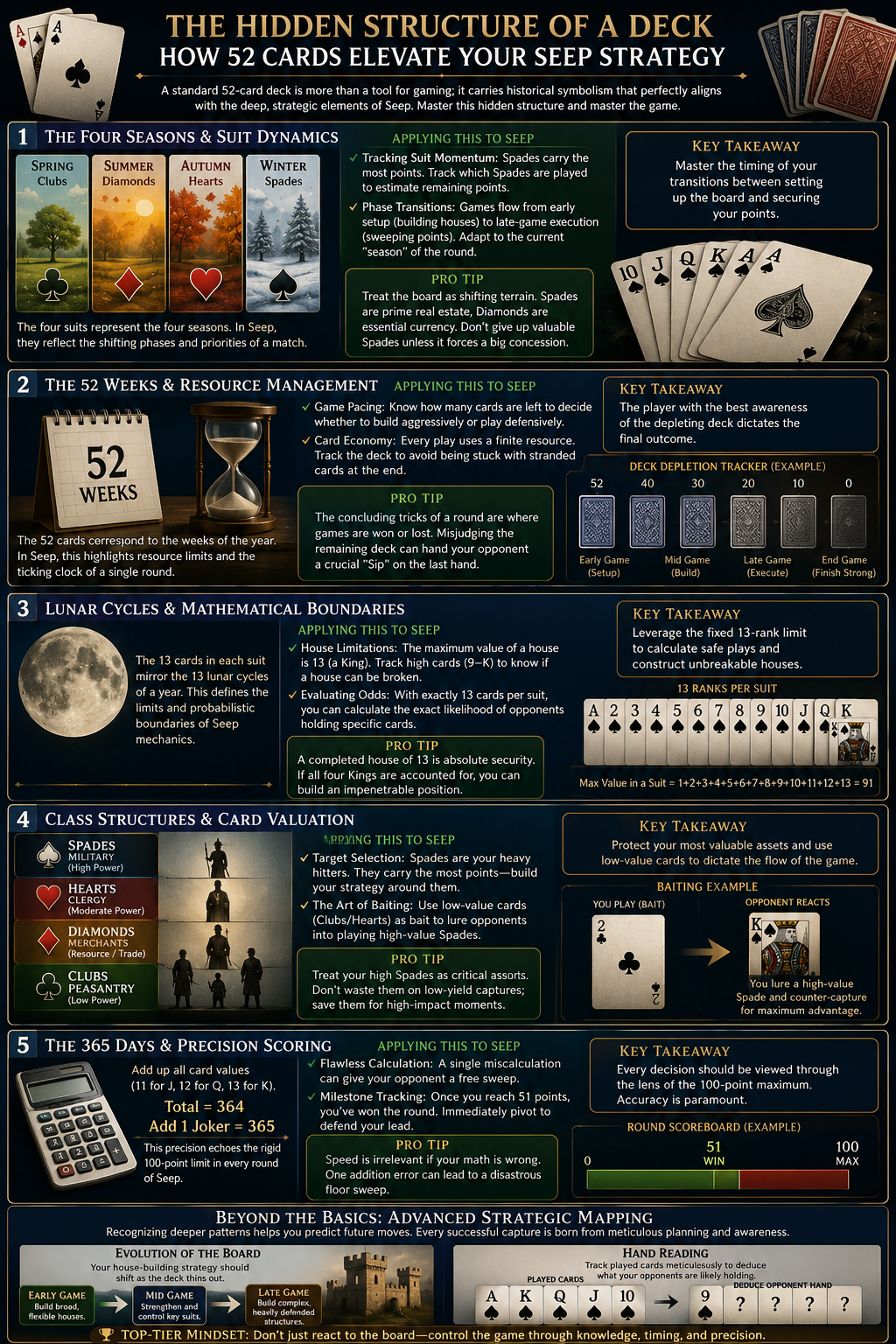
1. The Four Seasons & Suit Dynamics
Traditionally, the four suits are linked to the four seasons. In the context of Seep, they represent the shifting phases and priorities of a match.
Applying This to Seep
- Tracking Suit Momentum: Just as seasons change, your focus must shift based on the suits in play. Spades carry the bulk of the scoring weight. Monitoring which Spades have been played is vital for estimating the remaining points on the table.
- Phase Transitions: A game naturally flows from early setup (building houses) to late-game execution (sweeping points). Failing to adapt to the current "season" of the round often results in lost opportunities and wasted high cards.
2. The 52 Weeks & Resource Management
The 52 cards correspond to the weeks of the year. For a Seep player, this number highlights the strict limitations on resources and the ticking clock of a single round.
Applying This to Seep
- Game Pacing: Seep rewards patience and foresight. Knowing how many cards are left in the deck allows you to calculate whether it's safe to start an aggressive build or if you should play defensively to prevent a floor sweep.
- Card Economy: Every play consumes a finite resource. Keeping a rough mental count of the remaining deck ensures you aren't stuck holding stranded cards when the round concludes.
3. Lunar Cycles & Mathematical Boundaries
The 13 cards in each suit mirror the 13 lunar cycles of a year. This number defines the absolute limits and probabilistic boundaries of Seep mechanics.
Applying This to Seep
- House Limitations: The maximum value of a house in Seep is capped at 13 (a King). Tracking how many high-value cards (9s through Kings) have been played helps you determine if a house you are building can be broken or if it remains secure.
- Evaluating Odds: With exactly 13 cards per suit, astute players can deduce the exact likelihood of an opponent holding a specific card to counter their plays based on the discard pile.
4. Class Structures & Card Valuation
Historically, the suits represented different societal tiers—Military (Spades), Clergy (Hearts), Merchants (Diamonds), and Peasantry (Clubs). In Seep, this hierarchy directly translates to **card valuation and tactical priority**.
Applying This to Seep
- Target Selection: Spades, representing the 'Military', are your heavy hitters. Since they carry the most points, your strategy must revolve around maximizing your Spade captures per round.
- The Art of Baiting: Lower-value cards (like Clubs or Hearts) can be sacrificed as tactical bait. Offering a low-tier card might lure an opponent into dropping a high-value Spade, setting you up for a devastating counter-capture.
5. The 365 Days & Precision Scoring
If you add up the numerical values of a standard deck (assigning 11 to Jacks, 12 to Queens, 13 to Kings), the total is 364. Add a Joker, and you get 365. This mathematical precision echoes the rigid **100-point limit** in every round of Seep.
Applying This to Seep
- Flawless Calculation: Success in Seep demands rapid and accurate math. A single miscalculation when building a house doesn't just cost you a turn; it often grants your opponent a free sweep.
- Milestone Tracking: Because there are exactly 100 points available, tracking your score is crucial. Once you secure 51 points, you have won the round, and your strategy should immediately pivot toward defending your lead.
Beyond the Basics: Advanced Strategic Mapping
Recognizing the deeper patterns within a deck gives players a framework for **predicting future moves**. Every successful capture is born from meticulous planning and awareness.
Applying This to Seep
Evolution of the Board
Your house-building strategy should shift as the deck thins out. Focus on establishing broad, flexible houses early on, then transition to complex, heavily defended structures as the round nears its end.
Hand Reading
By meticulously tracking which cards have already been played, advanced players can deduce the remaining cards in an opponent's hand, allowing them to formulate uncounterable plays.
The Power Dynamics: Key Targets
The Ultimate Prize (Spades)
Spades dictate the flow of the scoreboard. Securing the **Ace of Spades (worth 9 points)** is a massive advantage that frequently decides the winner. These cards require absolute protection and prioritized capturing.
The Silent Decider (Diamonds)
While Spades draw attention, the **10 of Diamonds (worth 6 points)** is the game's secret weapon. Capturing this specific card often provides the crucial margin needed to win a tightly contested round.
Applying This to Seep
- Focused Aggression: Make the 10 of Diamonds and the high-value Spades your primary targets. These specific cards have a disproportionate impact on the final score.
- Calculated Defense: Never leave a high-scoring card vulnerable on the floor unless you possess the exact card needed to capture it or have safely integrated it into a secure house.
Color Theory: Offense vs. Defense
The visual divide between red and black cards is a perfect metaphor for the dual nature of Seep gameplay: **establishing control (Red) versus reaping rewards (Black).**
These cards are your primary tools for structural play. Utilize them to form houses and dictate your opponent's options without putting your own score at risk.
Black cards, primarily Spades, are the objective. They embody the points you are maneuvering to collect and must be handled with utmost care.
Applying This to Seep
- Strategic Layering: A common high-level tactic involves using Red cards to set up a secure board state, paving the way for a safe and lucrative Spade capture on a subsequent turn.
- Risk Assessment: Playing a Red card is generally a safer, foundational move. Exposing a Black card inherently carries more risk and should only be done when you have a clear plan to retrieve it.
Player Psychology & Behavioral Patterns
The way an opponent utilizes their face cards—Kings, Queens, and Jacks—can expose their **underlying strategy and mindset** for the entire round.
Applying This to Seep
- Analyzing King Plays: A player who hoards Kings is generally preparing for massive, late-game houses. They prioritize long-term stability over quick points.
- Analyzing Jack Plays: An opponent who uses Jacks rapidly for immediate, small captures is focusing on tempo. They want to disrupt the board and prevent you from gaining a foothold.
- Countering Playstyles: Identifying these tendencies allows you to adjust. For example, a tempo-focused player can often be trapped by establishing a complex, high-value house they cannot mathematically contest.